
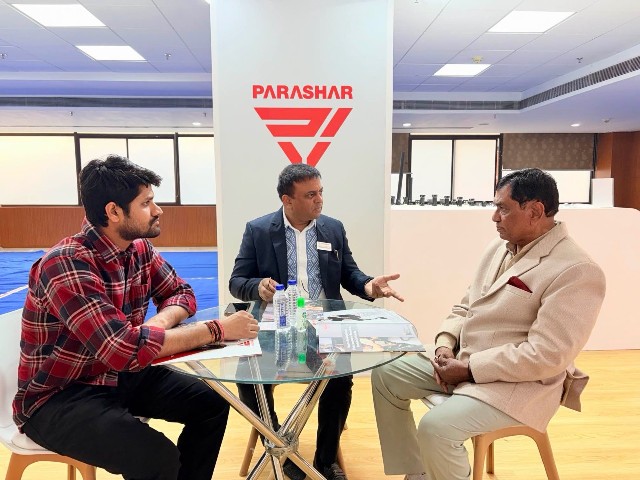
AHMEDABAD, GUJARAT | 06th FEBRUARY 2026 — Parashar Industries today underscored the critical role of indigenous manufacturing, quality-driven innovation, and long-term policy alignment in strengthening India’s prosthetics and assistive technology ecosystem, as the National Conference of the Orthotics & Prosthetics Association of India commenced at the Pandit Deendayal Upadhyay Auditorium, Ahmedabad. The conference brought together medical professionals, policymakers, researchers, and industry leaders to deliberate on the future of prosthetic and orthotic care in India.
With active participation from its leadership and technical teams, Parashar Industries used the platform to articulate a clear industry perspective that prosthetics and mobility aids must be positioned as enabling infrastructure within India’s healthcare and human capital framework, rather than as episodic welfare interventions.
The engagement comes at a pivotal policy moment following the Union Budget 2026–27, which reaffirmed the Government of India’s commitment to inclusive growth and a Viksit Bharat by placing Divyangjan and senior citizens at the centre of a technology-enabled empowerment agenda. The Budget reflects a decisive shift in public policy, recognising assistive technologies as foundational to participation, productivity, and dignity.
Drawing on global evidence and domestic experience, Parashar Industries highlighted that countries treating assistive technology as a strategic public investment consistently achieve higher workforce participation among persons with disabilities, improved health outcomes, and lower long-term welfare dependence. India’s current policy direction, the company noted, aligns closely with these globally established outcomes.
Speaking on the occasion, Nagender Parashar, Director, Parashar Industries, said, “Mobility is not merely about devices. It is about dignity, confidence, and full participation in society. When prosthetics are treated as enabling infrastructure, they unlock human potential and generate long-term social and economic returns. The Union Budget 2026–27 reflects this mature policy thinking, and industry must now respond with quality, scale, and accountability.”
Parashar Industries further emphasised the central role of innovation-led MSMEs in building a resilient assistive technology ecosystem. Globally, MSMEs form the backbone of prosthetics manufacturing, driving customisation, clinical relevance, and continuous improvement. With predictable procurement frameworks, research incentives, and pathways to scale, Indian enterprises can deliver world-class solutions while reducing import dependence and strengthening healthcare manufacturing self-reliance.
At the same time, the company stressed that scale must be matched with standards. Poor-quality or low-durability prosthetics lead to discomfort, injury, device abandonment, and erosion of trust in public systems. Robust quality benchmarks, transparent certification, and outcome-based monitoring are therefore essential to protect both fiscal efficiency and patient dignity.
Parashar Industries also highlighted that prosthetic care cannot be reduced to one-time device distribution. Effective outcomes require integration with skilled prosthetist training, rehabilitation services, and lifecycle maintenance. Without structured mechanisms for follow-up, adjustment, and repair, even well-funded initiatives risk remaining symbolic rather than transformative.
Reflecting on the broader policy shift, Dr Kirit P. Solanki, former Lok Sabha MP and senior medical professional, said, “India is witnessing an important reorientation in public policy. Prosthetics and mobility aids are not welfare measures, but essential enablers of dignity, productivity, and social participation. When assistive technology is treated as infrastructure, it delivers durable health, economic, and societal outcomes.”
Reaffirming its commitment to collaborative nation-building, Parashar Industries stated that translating policy intent into measurable impact will require sustained coordination between government, clinicians, and industry. As India advances its inclusive growth agenda, the company emphasised that quality, accountability, and long-term outcomes must remain central to the future of prosthetic and orthotic care.
¤¤¤¤ ¤¤¤¤ ¤¤¤¤
