
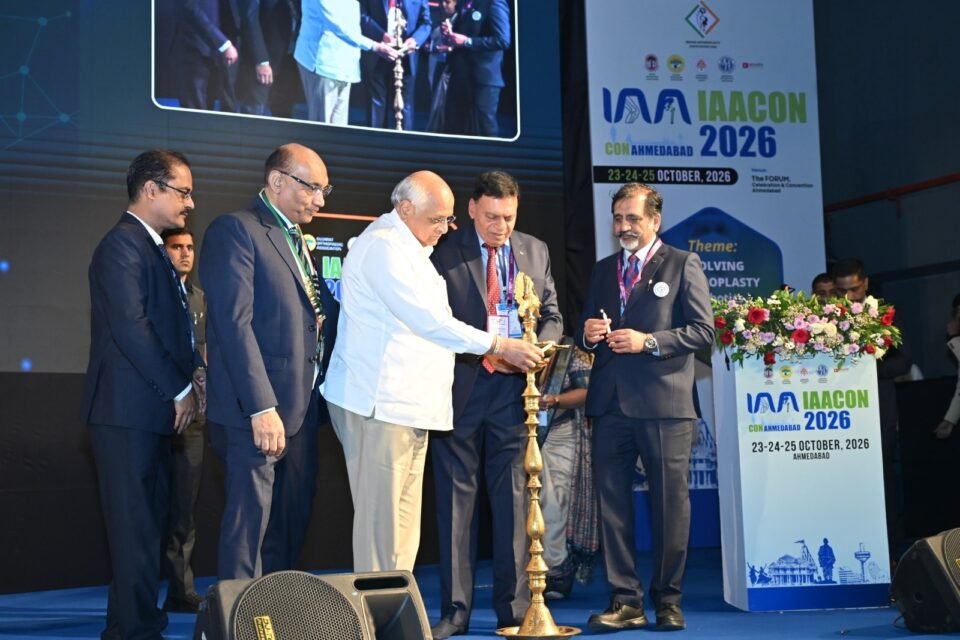
Ahmedabad : The 22nd Annual Conference of the Indian Arthroplasty Association, IAACON 2026, concluded successfully in Ahmedabad after three days of scientific exchange, clinical learning and discussions on the latest developments in joint replacement surgery. The conference brought together 205 national faculty members and nine international experts, along with hundreds of orthopedic surgeons and postgraduate students from across India, reaffirming the growing importance of arthroplasty as a rapidly advancing specialty in healthcare.
The event was jointly supported by the Indian Arthroplasty Association, Indian Orthopaedic Association, Gujarat Orthopaedic Association, Ahmedabad Orthopaedic Society and Ahmedabad Arthroplasty Association.
A recurring theme throughout the conference was the growing role of technology in enhancing surgical precision and patient-centred care. Experts highlighted that more than three lakh hip and knee replacement surgeries are performed annually in India. Gujarat was recognised as one of the country’s leading states in terms of joint replacement volumes, strengthening its reputation as a preferred destination for advanced orthopedic care.
The conference was preceded by a cadaveric workshop at B. J. Medical College, where approximately 70 faculty members and 180 delegates participated in hands-on training covering the direct anterior approach to hip replacement, unicondylar knee replacement and reverse shoulder replacement.
The conference was inaugurated by Gujarat Chief Minister Shri Bhupendra Patel, who underlined the transformative impact of joint replacement surgery on patients’ lives. He emphasized that restoring mobility enables individuals to regain independence, return to work and actively participate in community life, while continued advancements in surgical techniques and training help improve standards of patient care.
Speaking about the significance of the gathering, Dr. H. P. Bhalodia, Organising Chairman, said that IAACON 2026 created a valuable opportunity for surgeons to critically evaluate emerging technologies and exchange diverse clinical perspectives. He noted that collaborative learning and evidence-based discussions remain essential as newer tools enter orthopedic practice.
Dr. Dhiraj Marothi Jain, Organising Secretary, observed that the strength of a scientific conference lies in meaningful dialogue. He said the active participation of delegates and faculty enabled deeper understanding of complex clinical situations and contributed significantly to professional development.
One of the most prominent highlights of IAACON 2026 was the extensive focus on robotics and artificial intelligence in arthroplasty. Delegates participated in discussions and demonstrations involving image-based, imageless and AI-enabled 3D robotic technologies that are increasingly being integrated into modern surgical practice. Experts reviewed how these systems assist surgeons in pre-operative planning, bone preparation, implant positioning and real-time assessment of alignment and balance.
Held under the theme “Evolving Arthroplasty: Robotics, Kinematics & Innovation,” the conference served as a platform for examining emerging surgical technologies, sharing clinical experiences and exploring evidence-based approaches to improve patient outcomes in hip, knee and shoulder replacement procedures.
The academic programme featured 35 scientific sessions and four structured debates, complemented by surgical video presentations, complex case-based discussions and dedicated learning opportunities for young orthopedic surgeons. Interactive sessions encouraged detailed discussions on decision-making, surgical planning and management of challenging clinical scenarios. Topics ranged from implant alignment and design to infection prevention, surgical outcomes and enhanced recovery protocols.
As IAACON 2026 concluded, participants left with renewed insights into the future of arthroplasty, strengthened professional networks and a deeper understanding of technological innovations shaping orthopedic surgery. The conference successfully demonstrated how robotics, artificial intelligence, advanced imaging and evidence-based clinical practice are redefining joint replacement surgery while reinforcing the orthopedic community’s commitment to improving mobility, enhancing quality of life and delivering better outcomes for patients.
