
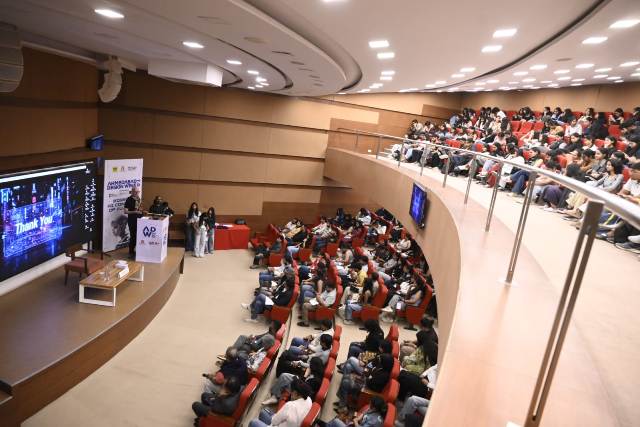
AHMEDABAD, GUJARAT | 31st JANUARY 2026 — Ahmedabad Design Week (ADW) 7.0 Day 2 reframed the conversation around Artificial Intelligence—moving decisively beyond hype to explore how AI can be integrated responsibly, ethically, and meaningfully into human-centered design practices. Hosted at the Karnavati University campus, the day brought together experts from fashion, film, engineering, finance, and education to examine how AI functions not as a replacement for creativity, but as a powerful laboratory guided by human intent.
AI as an Augmenter, Not a Replacement
Opening the day, Ayushi Anand and Vishal Yoman, Founders of Kalpnik Films, challenged the fear of AI-led job displacement. They positioned AI as a creative amplifier that enables new revenue models in animation and hyper-personalized media. Through live demonstrations using platforms such as Kling and Hailuo AI, they showcased fully AI-generated content while reinforcing that foundational design knowledge remains essential for ethical and effective use of technology.
Ankush Tiwari of pi labs.ai further expanded this idea, noting that while AI can generate infinite possibilities, it lacks intent, empathy, and cultural context. Building on this, KeshavSoni introduced the concept of “Vibe Coding,” where natural language replaces technical syntax, supported by a “Human in the Loop” framework to ensure accountability and ethical integrity. Together, the sessions emphasized AI as a collaborator—one that responds to human vision rather than dictating it.
Designing Technology with Empathy
Human behaviour and emotional intelligence emerged as critical design materials in Dhaval Joshi’s session, Teaching Machines to Care. He cautioned against convenience-driven design becoming an addictive interface and urged designers to incorporate micro-empathy and cultural relevance into digital experiences. From chatbots to consumer products, the focus, he argued, must remain on responsibility and meaningful interaction.
This approach extended into digital branding, where HimanshuGoel of CompanionzAI explored the rise of AI avatars and influencers such as Kyra. Demonstrating tools like HeyGen and Suno, he emphasized that AI-driven storytelling is most effective when it amplifies an authentic, expert-led voice rather than replacing it.
AI in Physical Design and Engineering
In industrial and architectural design, speakers demonstrated how AI is reshaping precision and efficiency. Zuowen Wang of Asustek described AI as “a laboratory, not a wishing well,” showing how structured prompts can translate sketches into complex design outcomes. Dhruv Gandhi of Simpliforge Creations shared insights into 3D concrete printing, highlighting projects that achieved up to 40% cost savings through synchronized collaboration between design and structural teams—including the world’s first 3D-printed temple.
Renuka Srinivasan of DassaultSystèmes introduced “Virtual Twin” technology, which simulates real-time behaviour to predict defects and reduce material waste across manufacturing and biomedical applications. Echoing the theme of relevance, Kshitij Rajput of boAt Lifestyle guided students on translating abstract ideas into a structured visual language that bridges “pixels and parts” for industry clients.
Industry, Education and the Future Designer
Across fashion and finance, AI emerged as a tool for resilience and speed. Urvashi Gupta of WGSN demonstrated how AI supports colour, material, and sustainability forecasting using the STEPIC framework, while Pratiq Shah of Deloitte showcased AI-driven fraud detection and predictive analytics. His message resonated strongly: “AI will not take away jobs—people who know AI better will.”
The day concluded with reflections on education and skill-building. Mr. Jens Kaeumle of SCAD encouraged students to become “poly-designers,” adaptable across disciplines, while Prof. Blair Kuys of Swinburne University emphasized the continued importance of material intelligence and tactile engagement. Both agreed that while AI enhances analysis and efficiency, human sensitivity, ethics, and critical thinking remain irreplaceable.
Ahmedabad Design Week 7.0 Day 2 ultimately reinforced a clear message: the future of AI in design is not about automation alone, but about responsibility, empathy, and intentional creativity—where technology serves humanity, not the other way around.
¤¤¤¤ ¤¤¤¤ ¤¤¤¤
