
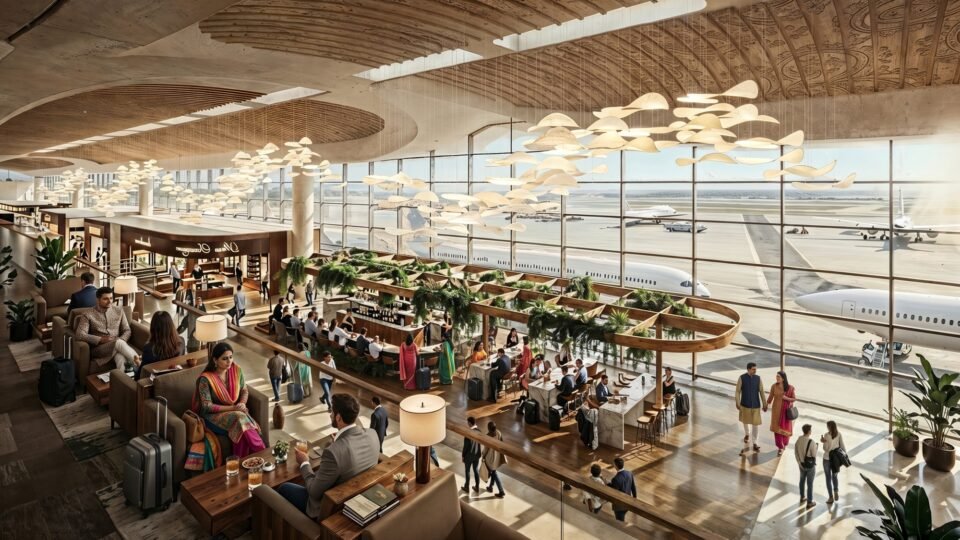
MUMBAI — Chhatrapati Shivaji Maharaj International Airport (CSMIA) shared artistic impressions outlining its vision for the redevelopment of Terminal 1 (T1) during its meeting with the Airport Airline Operators Committee (AOC). These visuals convey the passenger-centric architectural aspirations for Mumbai’s future gateway, presenting a vision of the terminal’s intended character and experience rather than a definitive preview.
Commissioned in 1964, the aging T1 is past its prime. Severe safety and structural vulnerabilities highlighted in independent audits by Structwel (2017) and IIT Bombay (2024) have made replacing this sixty-year-old facility an urgent necessity for public safety. Now, Mumbai is ready to shed the old and embrace the extraordinary.
A Passenger-Centric Architectural Vision
The artistic impressions envisage a terminal designed around passengers and the needs of Mumbai’s growing commercial capital. More than a facelift, the vision is to transform a fragmented legacy structure into a seamless, modern and culturally inspired gateway. The concepts illustrate the intended experience:
- Departure Kerbside: Envisioned as a sweeping, soaring entrance that creates a welcoming sense of arrival.
- Check-In Hall: Imagined as a vast, sunlit, column-free space, with local art murals reflecting Mumbai’s rich cultural heritage.
- Departure Hold Area: Visualised as an oasis-like environment with lush indoor greenery, premium lounges and expansive glass facades overlooking the runways.
- Arrival Kerbside: Envisaged as an open, artistic welcome, with a signature giant flamingo sculpture celebrating Mumbai’s natural biodiversity.
Engineering for Greater Capacity and Efficiency
Alongside the architectural vision, the redevelopment plans aim to enhance passenger processing capabilities:
- Capacity Expansion: Annual passenger handling surges by 33% from 15 mppa to 20 mppa.
- Frictionless Flow: Check-in counters increase by 47% (from 74 to 109), while security lanes expand 2.5x to feature 15 passenger lanes and 5 transfer lanes.
- No More Remote Boarding: Contact stands grow 3.5x from 7 to 25, while conventional boarding gates are replaced with 12 state-of-the-art e-gates.
- Rapid Baggage Reclaim: Reclaim belts more than double from 5 to 11.
Seamless Transition Strategy
To ensure Mumbai never stops flying, the transition will be meticulously phased. Demolition begins in April 2027, offset by the G+3 T2 North-West Pier expansion (operational by March 2029) to handle interim domestic traffic. The new T1 will rise in its place, with completion targeted for December 2030, taking BOM’s capacity to 65 mppa.
These artistic impressions express an ambition: to create a safer, more welcoming and distinctly Mumbai gateway. They bring the vision for the new Terminal 1 to life, with passenger experience, cultural identity and modern infrastructure at its heart.
