
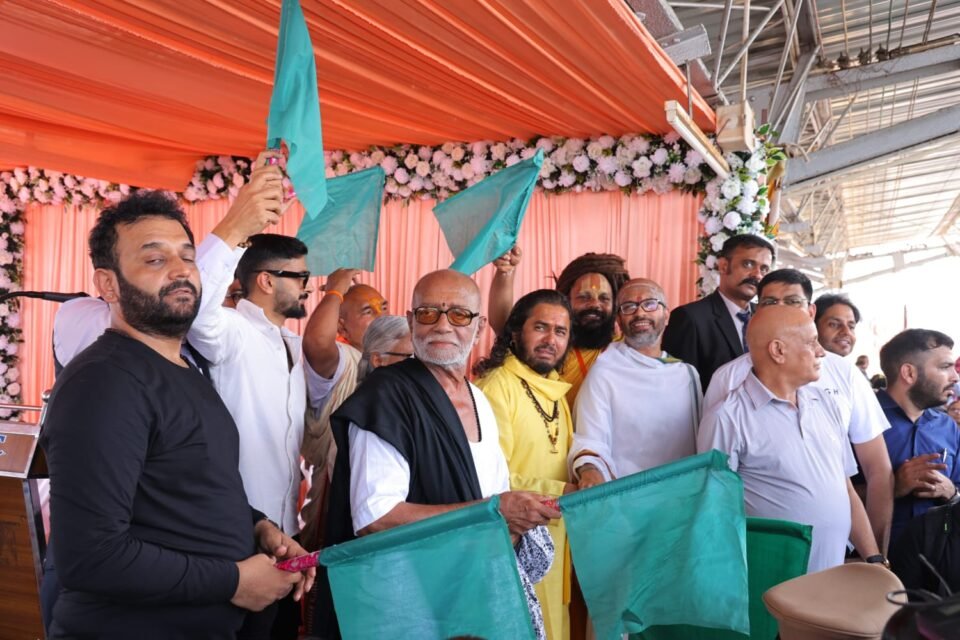
KANYAKUMARI | 10th OCTOBER 2026 | The southernmost tip of the mainland India witnessed the beginning of a spiritual journey across the country today, as Pujya Morari Bapu commenced the Bharat Swastik Yatra from Kanyakumari, embarking on the first railway leg of the pilgrimage towards Kedarnath.
The railway leg of the Bharat Swastik Yatra was ceremonially inaugurated at 11:00 am at Kanyakumari Railway Station in the presence of Pujya Morari Bapu and several distinguished guests. Among those present was Anand Ji, a representative of the Shankaracharya of Sringeri Sharada Peetham, along with Kum. B. Radha Devi, Jeevan Vrati Karyakarta and Secretary – Administration at Vivekananda Rock Memorial and Vivekananda Kendra, Kanyakumari; Satua Baba; Madan Paliwal; and Achyut Anurag of Indian Railways. The gathering of spiritual leaders, dignitaries, devotees and members of the local community marked the commencement of the historic journey, bringing together India’s spiritual traditions and the vision of national unity that underpins the Bharat Swastik Yatra.
Addressing the press conference Bapu said, “The Swastik represents auspiciousness, well-being and harmony, extending in all four directions. The Bharat Swastik Yatra carries this spirit and the prayer for the welfare of all. This journey is rooted in four key values: Tyag (sacrifice), Tap (penance and dedication), Titiksha (patience and endurance) and Tarpan (an offering in remembrance and gratitude). Tyag reflects the sacrifices made by those who have devoted themselves and their families to this endeavour. Tap represents the dedication and hard work of everyone who has worked to organise the Yatra, particularly Madan’s family and Rupesh. Titiksha is for those who could not join the journey but carry a deep and earnest desire to be part of it. And Tarpan holds special significance today, on Amavasya, the concluding day of the period of ancestral offerings, just before the beginning of Navratri tomorrow Yeh Yatra joh hai woh ati ati ati Durgam hai (extremely difficult ) but it will become sugam by the anugrah of lord Ram.
Together, these values give the Bharat Swastik Yatra its deeper meaning—a journey of sacrifice, dedication, patience and gratitude, undertaken with the prayer for the welfare of the entire world.”
The commencement of the Yatra was followed by the first Ram Katha of the journey at Vivekananda Kendra, Kanyakumari. The Katha began with Swasti Vachan by representatives of the Sringeri Sharada Peetham, invoking auspiciousness and seeking blessings for the journey ahead. This was followed by the screening of a special video message from the Param Pujya Jagadguru Shankaracharya Shri Bharati Tirtha Mahasannidhanam of Sringeri Sharada Peetham who conveyed his blessings and best wishes for the Bharat Swastik Yatra and its larger purpose of spiritual and national integration.
His holiness, Anand ji said, “If we think of Ram Katha as a cloud, then its divine nectar is Ramamrita, which Pujya Morari Bapu seeks to shower upon us through his words. The purpose of this spiritual journey is to help us overcome the Arishadvarga—the six inner enemies, including hatred, jealousy and other negative tendencies—and embrace Swasti, a state of well-being and harmony. The objective of the Bharat Swastik Yatra is not merely individual welfare, but the well-being of all humanity and the entire world. This, I believe, is the true spirit of this sacred initiative. We are blessed by the guidance and inspiration of our Gurudev, Param Pujya Jagadguru Shankaracharya Shri Bharati Tirtha Mahasannidhanam of Sringeri Sharada Peetham, whose blessings lend great significance to this endeavour.”
Beginning from Kanyakumari and moving towards the Himalayas, the Yatra seeks to symbolically connect the length and breadth of Bharat through its spiritual and cultural traditions. The first phase of the journey will travel from Kanyakumari to Kedarnath from October 10 to 23, passing through several important centres including Kalady, Sringeri, Hampi, Tuljapur, Omkareshwar, Jhansi, Mathura, Kurukshetra, Attari-Wagah and Jammu, before culminating at Kedarnath.
The idea behind the Yatra is to explore the deeper meaning of the Swastik and what it represents within Sanatan Dharma — auspiciousness, harmony, balance and well-being. Its four arms have traditionally been associated with different concepts, including the four directions, four Vedas, four Purusharthas — Dharma, Artha, Kama and Moksha — and the four stages of life.
The journey takes inspiration from the Swastik, a timeless symbol of svasti — well-being, welfare and auspiciousness. The four arms of the Swastik represent the four directions coming together, reflecting the central idea behind the Yatra — that the diverse regions of Bharat are part of one larger civilisational and spiritual continuum.
The journey from Kanyakumari to Kedarnath also recalls the travels of Adi Shankaracharya, who journeyed across Bharat with the spirit of connecting its diverse regions through Sanatan Dharma. Through the Yatra, Bapu seeks to carry forward the same larger spirit of connection, bringing together people from different regions and walks of life.
Around 900 devotees are accompanying Pujya Morari Bapu on the first phase of the Bharat Swastik Yatra aboard two special trains — Kailash Bharat Gaurav and Chitrakoot Bharat Gaurav, comprising 22 and 16 coaches respectively.
Pujya Morari Bapu started his narration for the devotees accompanying the pilgrimage on 2 yatras – Kanyakumari to Kedarnath and Dwarka to puri. Bapu has named them Manas Bharat Swastik Yatra, which will be his Katha Numbers 985 and 986 adding another significant chapter to his long-standing journey with the Ramcharitmanas.
The Yatra is bringing together spiritual leaders, Acharyas, scholars, udyogpatis, samajpatis, social leaders and community representatives, making the journey a collective expression of Bharat’s spiritual and cultural diversity.
The Bharat Swastik Yatra is being organised by Santkripa Sanatan Sansthan.
Madan Paliwal, Chairman, Miraj Group and Managing Trustee, Santkripa Sanatan Sansthan, said, “The beginning of the Bharat Swastik Yatra is a moment of collective faith and participation. What makes this journey special is that it is being undertaken not as an individual endeavour, but as a shared experience involving people from different walks of life. Through the Kathas, seva and the time spent together during the journey, we hope to create a space where people can reconnect with our values, with one another and with the deeper spirit of our civilisational heritage. For us, the true measure of this Yatra will be the sense of togetherness and goodwill it leaves behind at every step.”
The first phase will culminate in Kedarnath on October 23, while the second phase will begin from Dwarka on November 14 and conclude at Jagannath Puri on November 22, completing the larger Swastik across the country.
For Morari Bapu, whose Ram Kathas have consistently carried the message of Satya, Prem and Karuna — Truth, Love and Compassion, the Yatra is an extension of these values into a journey across Bharat. The Ram Katha and associated programmes during the Yatra are open to all, with bhandara (vegetarian community meals) being organised at every location as prasad.
== ENDS ==
